How Much Does Pool Removal Cost in Fort Worth?
National cost guides put a partial pool removal at $3,000 to $7,000 and a full removal at $5,000 to $16,000, with HomeAdvisor’s overall average at $8,000. There is no separate Fort Worth price index, but the same things move the number here: the size of the shell, gunite versus fiberglass, how a machine gets into the backyard, and how much fill dirt the hole takes. Fort Worth clay adds one driver of its own.
| Removal type | Typical range | Source |
|---|---|---|
| Partial removal (collapse and fill in) | $3,000 - $7,000 | Fixr |
| Partial removal | $2,000 - $7,000 | HomeAdvisor |
| Full removal (entire shell out) | $5,000 - $15,000 | Fixr |
| Full removal | $9,000 - $19,000 | HomeAdvisor |
| Above-ground pool | $300 - $800 | HomeAdvisor, Bob Vila |
| Concrete pool deck removal | $500 - $1,700 | HomeAdvisor |
| Fill dirt | $8 - $12 per cubic yard | HomeAdvisor, Fixr |
| Permit | $50 - $250 | HomeAdvisor, Fixr |
Those are published national numbers, not a quote. A real price needs someone standing in the backyard with a tape measure. Our pool demolition service in the Fort Worth area prices every job at the property, free.
What is the difference between partial and full pool removal?
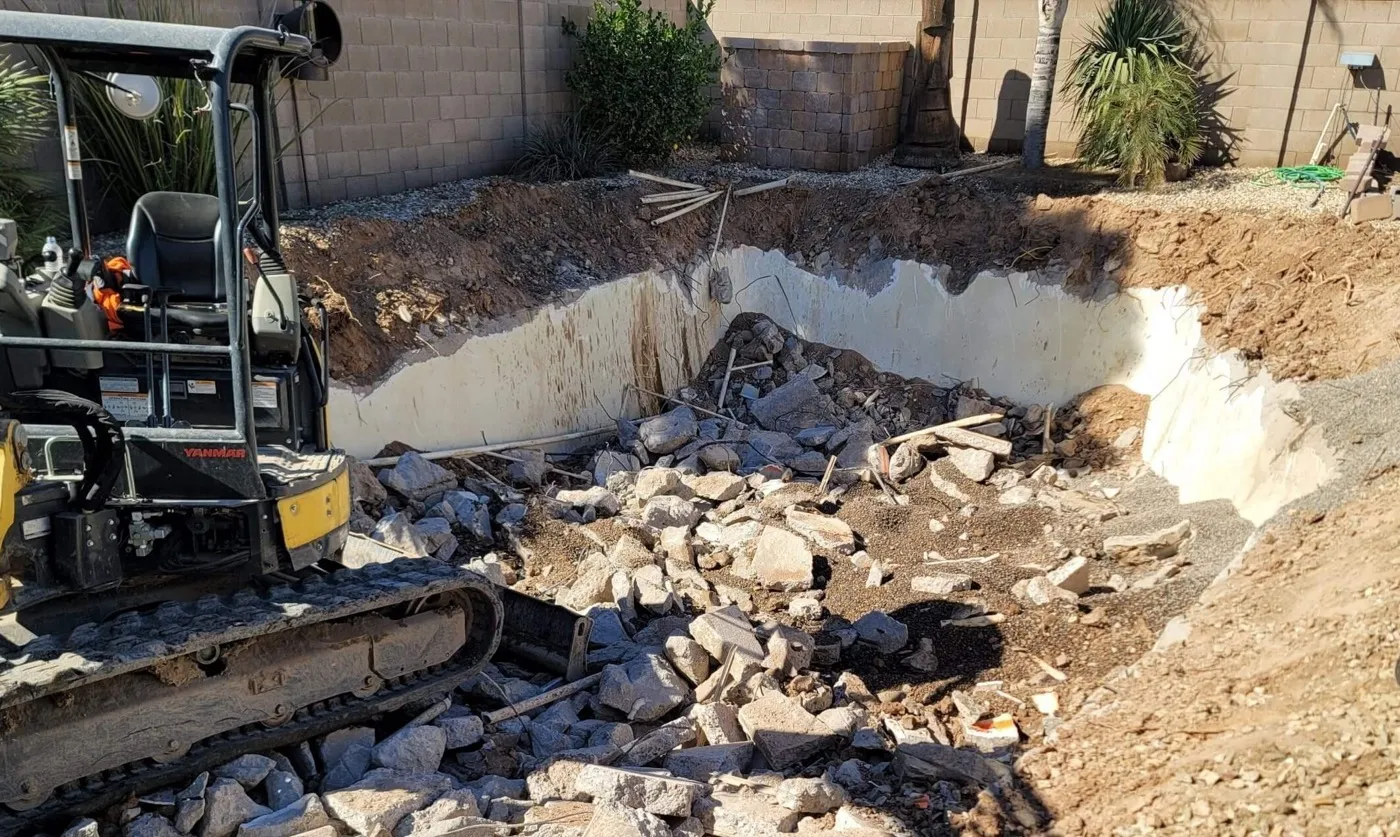
Partial removal breaks the walls down below grade, punches drain holes through the floor, and fills the shell with the rubble and compacted dirt. Full removal takes the entire shell out, walls and floor, and hauls all of it off. Partial costs less and finishes faster. Full leaves ground you can build on.
Bob Vila puts a collapse-in-place partial at $4,500 to $6,250 and a full removal at $4,000 to $16,000, or about $9,000 on average. Fixr’s partial range is $3,000 to $7,000. The gap between the two comes down to how much concrete leaves the property. In a partial job most of it stays in the hole. In a full job every load rides out in a dumpster.
Material decides which one you can even choose. Fixr notes that partial removal works on concrete pools and some vinyl pools, while fiberglass shells and some vinyl liners have to come out whole. HomeAdvisor’s ranges by material run $3,000 to $10,000 for vinyl, $3,000 to $15,000 for concrete, and $5,000 to $10,000 for fiberglass.
What drives the price of pool removal up?
Four things push a pool removal past the averages: a big or thick gunite shell, a fenced backyard with no gate wide enough for a machine, a large concrete deck, and a lot of fill dirt hauled in. Each one adds hours, loads or material, and each one is visible on a site visit.
Access. Most pools sit behind a house and a gate. A compact excavator fits through a standard gate, and a wider machine means a fence section comes out and goes back. HomeGuide lists ease of access alongside disposal fees and local labor rates as the main cost factors.
Decking and extras. HomeAdvisor budgets $500 to $1,700 to remove a concrete pool deck, and a spa, waterfall or outdoor kitchen adds work on top. The deck is concrete removal in its own right, and it usually goes in the same dumpster as the shell.
Disposal. Bob Vila puts a rented dumpster at $200 to $800 per week for a homeowner-run job. Our roll-off trucks and dumpsters haul the rubble off our own jobs, so that line does not show up as a separate rental.
Fill and compaction. Dirt runs $8 to $12 per cubic yard, and Angi budgets $320 to $800 for compacting it. A mid-size pool needs something like 60 cubic yards, so the fill is a real line item, and on Fort Worth clay it is the one you should never cut.
Why does Fort Worth clay change how a pool gets filled?
Much of the Fort Worth area sits on expansive clay that swells when wet and shrinks when dry. Loose fill on top of that clay settles for years and leaves a dip over the old pool. The fix is compaction in thin layers, with the fill kept near the right moisture, and a finished grade that sends water away from the house.
The USDA soil survey describes Houston Black clay, the soil under much of the eastern Grand Prairie and the Blackland Prairie, as 40 to 60 percent clay with surface cracks a half inch to 4 inches wide that reach a foot deep or more in dry weather. The Texas A&M AgriLife Master Gardeners in Ellis County put it plainly: the smectite clay in that soil “is what swells and shrinks and ruins our foundations.”
That is why compaction is not a detail on a pool job. TxDOT’s standard for clay embankments limits each layer to 12 inches after compaction and requires the soil to stay within a few points of optimum moisture while it is packed. A backyard pool fill is not a highway, but the same rules apply: thin lifts, packed one at a time, on ground that is not bone dry. The dirt work and grading on a pool removal are the parts you live with for the next 20 years.
Do you need a permit to remove a pool in Fort Worth?
Yes, in almost every case. Fort Worth’s building code says no one may raze or demolish “any building or structure” in the city without a demolition permit from the building official. The city treats swimming pools as accessory structures for building permits, and its wrecking and razing application carries an “Accessory Structure” box. The city does not publish a pool-specific demolition page, so confirm the exact form and fee with Development Services before you set a date.
The suburbs run their own desks. Arlington’s fee schedule effective June 1, 2026 lists a demolition permit at $200 per building. Burleson lists both demolition and swimming pools among the work that needs a permit. National cost guides put pool removal permits at $50 to $250, and Fort Worth may sit above or below that. Your contractor normally pulls the permit, and a job done without one can turn into a problem when you sell.
How long does pool removal take?
Two to seven days of machine work for most backyard pools. HomeAdvisor puts a partial removal at one to three days and a full removal at three to seven. Fixr’s ranges are two to five days for a partial and five to seven for a complete removal. The permit and the utility disconnect happen before that clock starts.
Weather stretches the schedule more than anything else here. Wet clay will not compact, so a rainy week can pause the fill while the demolition itself is already done. The pool has to be drained first too, and the electric to the pump and any gas line to a heater have to be cut and capped before a machine comes over the fence.
Does a filled-in pool have to be disclosed when you sell?
Texas sellers fill out the TREC Seller’s Disclosure Notice, and the current form has no line that names a filled-in pool. It does ask about subsurface structures or pits, about landfill, settling and soil movement, and about alterations made without permits. A collapsed shell in the ground can touch all three, so keep the permit, the final inspection and any record of how the fill was compacted.
That paperwork is also what a future buyer’s inspector will ask for. A pool removal done with a permit and compacted fill is a selling point. One done on a weekend with a rented machine and loose dirt is the reason the disclosure form has those questions.
How do you get a real number for your backyard?
Someone has to look at the pool, the gate, the deck and where the dirt will come from. Those four things turn a $3,000 to $16,000 range into a single price. It takes a few minutes at the property.
Texas Best Demolition works out of Burleson and covers Fort Worth, Arlington, Mansfield, Crowley and the rest of the southwest Metroplex. We break the shell out with our own excavators, haul the rubble in our own roll-off dumpsters, and compact the fill in lifts with the same crews. Estimates are free. Call (817) 564-4360 or request a free estimate.