What Is Select Fill? Select Fill vs Fill Dirt for House Pads in Fort Worth
Select fill is fill dirt that meets a written spec for the ground under a slab or a building pad. The builder’s engineer or the geotechnical report sets its numbers, including the plasticity index, or PI. Engineers call for it because the heavy clay around Fort Worth swells wet and shrinks dry.
Published specs set different numbers for select fill, so the plan for your lot decides what qualifies. We haul select fill in and place it in lifts for house and shop pads built to the plan. We build to the elevations and specs the builder or engineer gives us. When the plan calls for it, a testing lab checks the density.
What is select fill?
Select fill is fill dirt picked for the job it does under a building. The national cost guides price it as structural fill. HomeGuide describes structural fill as screened dirt that is highly compactable. HomeGuide says it is typically a mix of small stones, clay and enough sand to promote good drainage.
HomeGuide adds that geotechnical engineers order a carefully designed fill dirt blend for the weight a project carries. Fort Worth’s residential code puts that design in an engineer’s hands. Section R401.2 says every foundation the code regulates is designed and sealed by a Texas-registered engineer. The same section says fill soils that support footings and foundations are designed, installed and tested by accepted engineering practice.
One published example comes from the Town of Northlake, a Denton County town north of Fort Worth. CMJ Engineering wrote an October 2023 geotechnical study there for one public building, the Northlake Stars Center. It calls for non-expansive select fill made of sandy clay or clayey sand. That select fill has a liquid limit under 35 and a PI between 5 and 16.
TxDOT writes its own fill spec for highway embankment, called Item 132. Its Type A material is granular and free of vegetation or other objectionable material. Type A holds the liquid limit to 45 or less and the PI to 15 or less. Northlake and TxDOT land on different numbers, which is why each plan names its own.
How does select fill compare to fill dirt, topsoil and sand?
Each material has its own job on a lot. The national cost guides price each one by the cubic yard, and each row names its publisher.
| Material | What it is for | Price per cubic yard | Publisher |
|---|---|---|---|
| Select fill, priced as structural fill | Building a new foundation or swimming pool | $10 to $30 | HomeGuide |
| Select fill, priced as engineered structural fill | Under foundations or roads | $15 to $25 | Angi |
| Fill dirt | Leveling holes and raising the ground level | $5 to $25 | HomeGuide |
| Basic unscreened fill | Raising or filling where precision isn’t critical | $8 to $15 | Angi |
| Topsoil | Planting or gardening | $10 to $50 | HomeGuide |
| Topsoil | Filling low spots before new lawn seeding | $12 to $55 | HomeAdvisor |
| Sand, delivered | Construction sand around paver stones or below a pool | $15 to $50 | HomeGuide |
| Screened loam | Lawns, shrubs, trees and flowers | $18 to $26 | HomeGuide |
HomeGuide calls standard fill dirt an inorganic subsoil, with broken-down rock, clay and sand in it. It fills holes and raises grade. Topsoil and loam are growing soils, and HomeGuide calls loam the ideal plant soil mixture.
Select fill is the support layer, and its plan names the spec. Low spots take common fill dirt instead. Our fill dirt and select fill hauling brings either one to the lot on our own trucks and trailers.
Why does Fort Worth clay make builders call for select fill?
Tarrant and Johnson Counties sit on heavy clay that swells wet and shrinks dry. A slab poured on that clay moves when the clay does. The Northlake study warns that a ground-supported floor slab can heave considerably if placed on dry, expansive clays.
PI is how a lab puts a number on that clay. TxDOT’s test procedure, Tex-106-E, describes PI as the moisture over which a soil stays plastic. Plastic means moldable, somewhere between semisolid and liquid. PI is the liquid limit minus the plastic limit, and the lab measures both.
TxDOT’s Tex-104-E defines the liquid limit as the moisture where a soil changes from a plastic to a liquid state. Sand sits at the low end. Tex-106-E has a separate step for non-plastic sand with a low PI.
Fort Worth’s residential code uses PI to flag expansive soil. Section R403.1.8.1 lists four soil tests, and a soil that meets all of them counts as expansive. The first test is a PI of 15 or greater. The code also accepts one test, an Expansion Index over 20, in place of the first three.
Section R401.4 covers lots where expansive soil is likely. There the building official decides whether a soil test is required. An approved agency runs that test with an approved method.
The Northlake study names the usual fix in its area. It says the more common methods place non-expansive select fill beneath the slab and moisture condition the soils. Its pad puts at least 1 foot of select fill over at least 10 feet of moisture-conditioned clay. The study expects that pad to hold slab movement to about 1 inch.
The study also says these methods will not eliminate the risk of unacceptable movement. Outside the building, it adds a single 6 to 8 inch lift of select fill to limit drying during construction. The Northlake select fill runs a PI of 5 to 16. TxDOT’s Type A tops out at 15, and the code’s expansive-soil test starts at 15.
How does select fill go down under a house pad?
The first step is taking out what a slab cannot sit on. Section R506.2 of Fort Worth’s code has vegetation, topsoil and foreign material removed inside the foundation walls. On a teardown lot, the old house and its slab come out before that.
The Northlake study starts by removing old pavement, surface vegetation and organic topsoil. It estimated 4 to 6 inches of stripping on that site. Then the fill goes down in thin layers called lifts.
The study keeps each loose lift of select fill to 9 inches or less. TxDOT’s Item 132 allows up to 16 inches loose or 12 inches compacted on highway embankment. Each spec sets its own lift, and the plan’s number is the one we build to.
Water comes next. The Northlake study compacts select fill at 2 points below to 3 points above the soil’s optimum moisture content. Optimum moisture is the water content where that soil packs best in the lab test. Each lift goes to at least 95 percent of Standard Proctor density, the ASTM D 698 lab target.
The study places the select fill within 48 hours of finishing the moisture-conditioned clay. It has an experienced geotechnician observe and test the earthwork on a continuing basis. On our pads, we spread and compact each lift to the plan. When the plan calls for density checks, a testing lab does them.
Fort Worth’s code also caps fill under a house slab. Section R506.2.1 allows up to 24 inches of clean sand or gravel, or 8 inches of earth. Deeper fill needs approval. A thicker select fill layer under a house is a call for the engineer who seals the foundation.
Once the pad is up, the ground around it has to shed water. Section R401.3 has lots graded to drain surface water away from the foundation. Its base rule is a fall of at least 6 inches within the first 10 feet. Our grading around a finished pad shapes that fall.
What does select fill cost?
The national cost guides price select fill as structural fill. HomeGuide puts engineered or structural fill at $10 to $30 per cubic yard, or $8 to $23 per ton. Angi lists engineered structural fill at $15 to $25 per cubic yard. HomeGuide ties the price to the type of fill, how much is ordered and how far it travels.
By the truckload, HomeGuide puts structural fill dirt at $250 to $400. That price assumes about 10 to 14 cubic yards, free delivery up to 10 miles and no installation. HomeGuide adds $200 to $400 for installation and spreading.
Yardage drives the total. Take a 60 by 45 foot slab footprint and a plan that calls for 8 inches of select fill. Eight inches is two-thirds of a foot, so 60 times 45 times two-thirds is 1,800 cubic feet. Angi’s method divides by 27, so the pad needs about 67 cubic yards.
At HomeGuide’s 10 to 14 cubic yards a load, that is five to seven truckloads. Fill packs down as each lift is compacted, so the order runs above the paper yardage. Our guide to fill dirt prices around Fort Worth covers common fill and delivery costs. We price select fill hauling and pad work at the property, and the estimate is free.
Who hauls and places select fill around Fort Worth?
We work out of Burleson, and Fort Worth’s south side is our biggest market. Pads in Burleson and northern Johnson County sit on the same heavy clay. Decades of demolition and dirt work sit behind the company, and about 20 people work here.
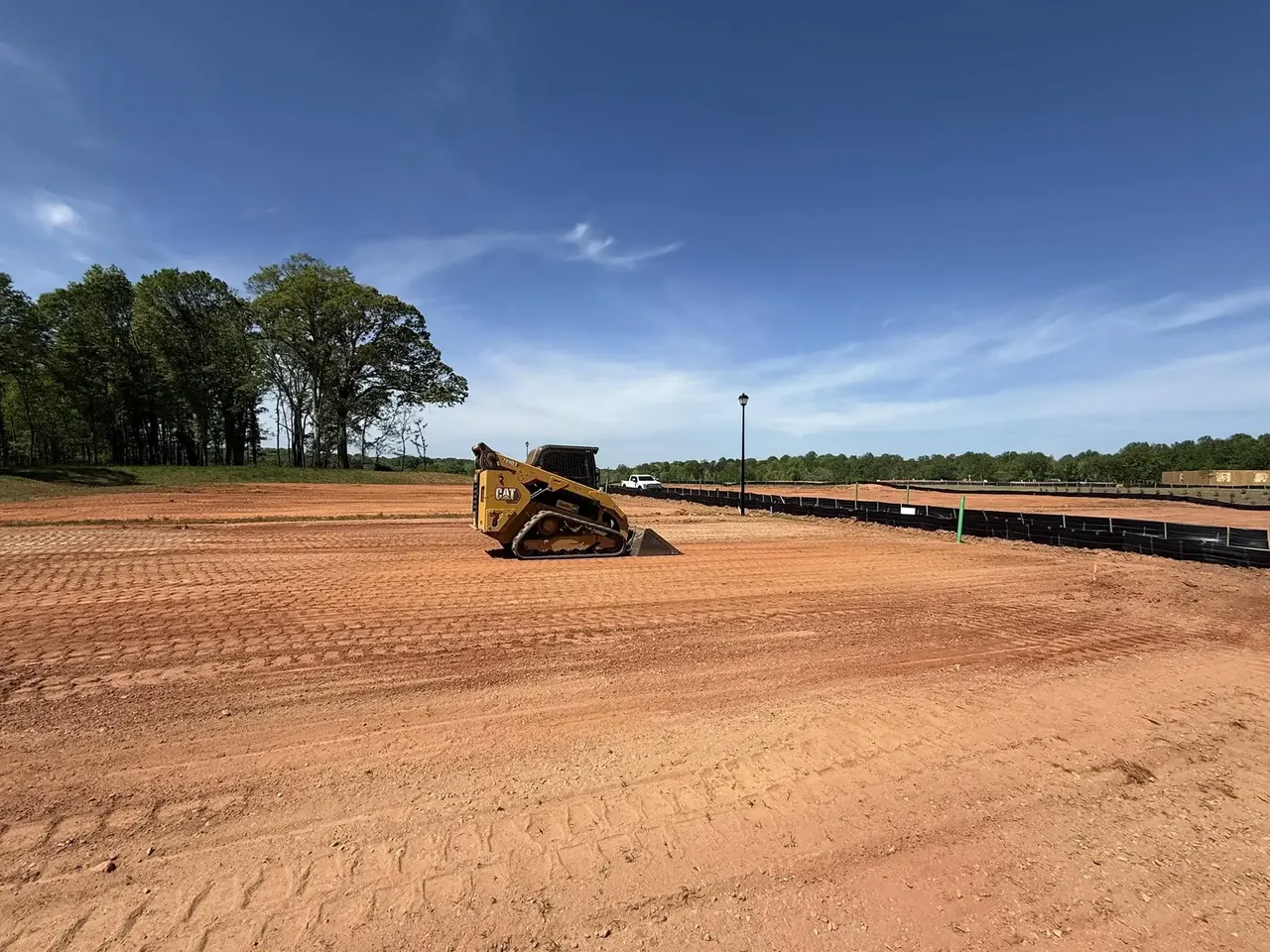
High-side end-dump trailers pulled by road tractors bring the select fill in. Dozers, wheel loaders and three skid loaders spread each lift. The builder or engineer sets the elevations and the spec, and we build the pad to them. Ask for a free select fill estimate with the plan and the address.